
Policy
Why Is PNG's Government Only Empowering Half the Country?
by Li Richards · September 18, 2026
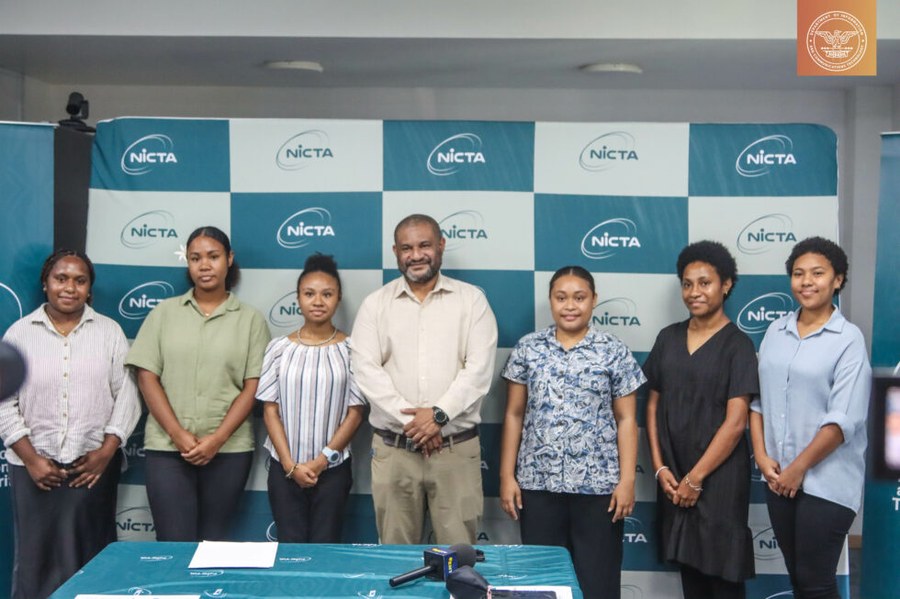
Photo source: NICTA
Somewhere in Port Moresby right now, a father is looking at a government scholarship ad and doing some quiet math. His daughter can apply. His son can’t. Not because his son failed a test, missed a deadline, or lacks the grades — but because he was born the wrong sex. The scholarship is real. It’s called Girls in ICT, it’s run by the National Information and Communications Technology Authority (NICTA), and it has been quietly funding tuition, laptops, stipends, and lodging for female students since 2016. As of this year it has 10 active scholars, and since inception it has supported more than 40 young women, with 19 already working in the industry.
Good for them. Genuinely. But here’s the question that father — and a lot of PNG parents — should be asking out loud: why is a government regulator, funded by everyone’s taxes, in the business of picking a favourite sex?
If a private company or an NGO wants to spend its own money exclusively on women, that’s their prerogative — nobody elected them to represent the whole country. But NICTA isn’t a charity. It’s a state authority. Every citizen, male and female, pays into the system that funds it. And a government that collects from everyone but only invests in half of them isn’t practising equity. It’s practising favouritism with better branding.
To be fair to NICTA, there’s a real, defensible reason for this specific program: ICT and STEM fields in PNG, as in most of the world, remain heavily male-dominated, and the scholarship is explicitly modelled on an International Telecommunication Union push to get more women into tech careers. That’s a legitimate, narrow policy target — closing a gender gap in one profession, not a blanket statement about who deserves education. So the “why only girls” question has a specific answer here, even if you don’t love the answer.
But zoom out from NICTA and the picture gets murkier, not clearer. Because when you look at the general state of gender and opportunity in PNG, the story government messaging tells — “women are falling behind, men are fine” — doesn’t hold up as neatly as the ad campaigns suggest. Some data shows PNG girls still trail boys in overall school access, particularly at secondary level, and face real barriers like early pregnancy, family pressure to stay home, and safety risks at school. Other more localised studies — one in Simbu Province, for instance — found dropout rates were roughly gender-neutral, with boys and girls leaving school in almost equal numbers, mostly because of poverty, not sexism. PNG’s own data on this is genuinely patchy and, in places, contradictory. So when a government body implies a clean, universal story of female disadvantage to justify a girls-only pipeline, it’s simplifying something that researchers themselves admit is messy.
Meanwhile, walk two blocks from that same scholarship office and you’ll find the part of the equation nobody’s funding: a generation of young men with nothing to do and nowhere to go. PNG’s youth unemployment is a genuine crisis, and it’s overwhelmingly the male half of that unemployed youth population that ends up recruited into raskol gangs, driving Port Moresby’s reputation as one of the most violence-plagued cities on earth — homicide rates that rival war zones, carjackings, armed robbery. Researchers studying gang culture in Port Moresby describe unemployment among young men as near-universal in the settlements gangs recruit from. This isn’t a coincidence of geography. It’s cause and effect. Idle, undereducated, unsupported young men don’t just harmlessly disappear — they become the state’s biggest law-and-order problem, and often, the direct source of the very violence against women that gender policy claims to be fighting.
And that’s the part that should make everyone uncomfortable, not just fathers of sons. PNG’s gender-based violence numbers are horrifying by any measure — national surveys have found well over half of women report physical violence, and roughly a third report sexual violence, with some studies putting lifetime rates even higher. Nobody sane disputes that this is a five-alarm national emergency. But here’s an uncomfortable question worth sitting with: who is committing that violence? Overwhelmingly, men. So if the strategy is “educate and empower women, full stop,” what exactly is that strategy doing about the men actually causing the harm? Nothing. You can hand every woman in the country a laptop and a scholarship, and it will not stop a husband with no job, no education, and no model of respect for women from raising his fist. If anything, some research on gender-based violence in PNG has found that more educated, more empowered women can face more backlash violence, not less — a brutal irony that should be central to this conversation, not a footnote.
This isn’t an argument against helping women. It’s an argument against a one-sided strategy that pretends men aren’t half of the equation — as fathers, husbands, brothers, and, uncomfortably, perpetrators. If the goal is genuinely safer homes and a functioning society, then boys need to be taught respect, discipline, and how to handle rejection, frustration, and power without violence, just as urgently as girls need scholarships. You don’t fix a two-person problem by only educating one of the people in the room.
There’s also a plainer fairness argument that doesn’t need any of the above statistics to land: everybody votes. Everybody pays tax, formally or informally, directly or through the price of everything they buy. A government’s job is to serve the whole electorate, not curate winners by sex. An NGO spending private donor money on girls-only programs is exercising its right to choose its mission. A state regulator spending public money the same way is choosing on behalf of people who never got a vote on that choice.
None of this requires abandoning support for women — PNG’s gender gaps in violence, health, and political representation are real and well documented, and deserve serious, sustained investment. It requires adding a second track alongside it: real investment in boys and young men — vocational training, mentorship, job creation, and yes, education in respect and accountability — funded with the same seriousness as the girls-in-ICT model. Not because men are more important. Because a society doesn’t get fixed by lifting up only one half of it and hoping the other half behaves.
So here’s the question worth putting to NICTA, and to every ministry running a “women and girls” program with public money: if you’re serious about safety, equity, and a functioning PNG, where’s the equivalent scholarship, the equivalent stipend, the equivalent laptop, for the boy on the other side of that same classroom?