
Foreign Affairs
The Pukpuk Treaty: Are We Signing PNG's Sons Up for Someone Else's War?
by Li Richards · September 19, 2026
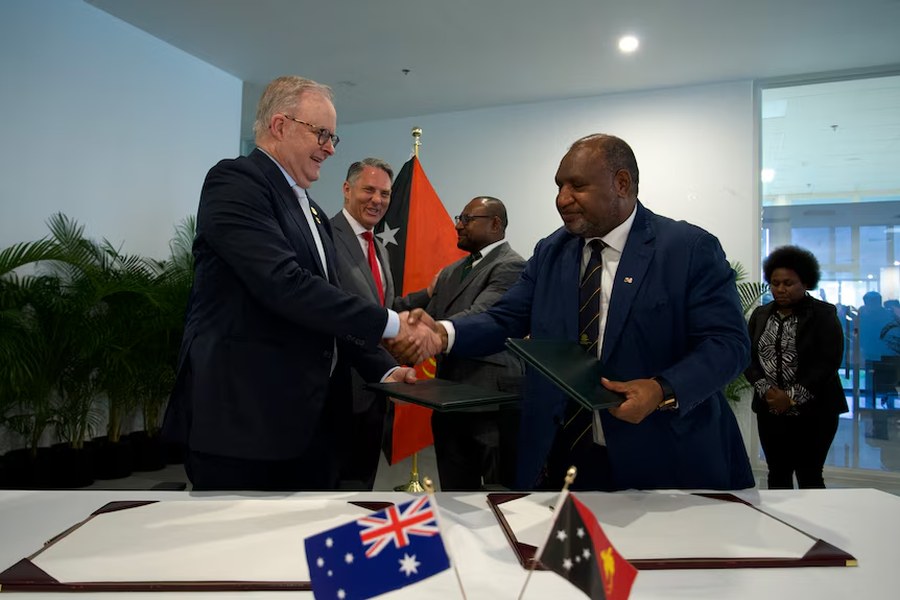
Photo source: ABC News
Every year we get a public holiday to remember men who died on our soil, in a war that was never ours. I’m not complaining about the day off — I’ll take a long weekend commemorating just about anything — but somewhere between the church service and the barbecue, it’s worth asking why we’re the ones lighting candles for other people’s soldiers. Australians and Americans fought the Japanese up and down the Kokoda Track in 1942 to defend Australia, not Papua New Guinea. We just happened to be standing on the battlefield. Around 625 Australians were killed and roughly 1,600 more wounded or struck down by illness during that campaign. The number of Papuan carriers, guides, stretcher-bearers and villagers who died supporting that effort was never properly counted — one detailed local study has documented at least 759 named deaths among the carrier line alone, and Australian commemorations often cite an estimate as high as 50,000 Papuans who served in support roles, but by every honest account the true toll was simply never written down, because nobody thought it needed to be. We remember ANZAC Day and Remembrance Day. We rarely get asked to remember them our way.
So forgive me if I raise an eyebrow at the Pukpuk Treaty.
For anyone who’s been too busy watching the PNG Chiefs sign one NRL superstar after another to notice, the Pukpuk Treaty is the mutual defence pact Australia and Papua New Guinea signed in October 2025 and brought into force on 8 July 2026. It’s Papua New Guinea’s first-ever formal alliance with any country, and Australia’s first new alliance in more than seventy years. Named after the Tok Pisin word for crocodile, it commits both nations to consult, cooperate and — this is the part that matters — “act to meet a common danger” if either is attacked. It also opens a pathway for Papua New Guineans to join the Australian Defence Force, with officials talking about thousands of recruits over the next decade and a possible route to Australian citizenship attached.
Here’s my question, and I’d like you to sit with it for a second before you answer: if China and Australia ever came to blows, where do you think that fight would actually happen?
Because history has already answered this one for us. It won’t be fought in Sydney or Canberra. It will be fought here, on our beaches and in our mountains, the way it was in 1942 — while the decision-makers who signed us up for it watch from somewhere considerably safer. When war comes, it isn’t the politicians in Waigani who dig the trenches. It’s the ordinary boys from the villages and the settlements who’ve never read a page of this treaty, let alone been asked what they think of it.
And that’s the part that should bother us more than it apparently does. This is meant to be a defence treaty, not a recruitment drive dressed up in patriotic language — but for a country where more than half the population is under 25 and formal youth unemployment sits stubbornly high, “thousands of jobs in the ADF” is an extraordinarily persuasive sales pitch. Some Papua New Guineans genuinely welcome it: a former PNGDF colonel told Radio Free Asia he saw it as a straightforward employment opportunity for school leavers our own leaders haven’t managed to employ. That’s a fair point, and it’s not one I want to wave away. But an opportunity and an obligation are two different things, and this treaty is both. Once you’re wearing someone else’s uniform, “just cause” stops being your call to make.
It’s also worth being honest about how thin the public conversation was before this treaty landed. The comparable US-PNG defence pact — the one giving American forces access to Lombrum naval base on Manus — did draw genuine, organised protest: students from the University of PNG, UNITECH, the University of Goroka and Mt Hagen Technical College marched, petitioned Parliament and demanded the government table the full document before signing anything. That’s real civic pushback, and credit to them for it. But when it comes to the Pukpuk Treaty itself, the resistance has come mostly from the top — an opposition leader warning it threatens “constitutional authority,” retired generals like Jerry Singirok openly questioning whether folding the PNGDF into Australian command structures is even constitutional — rather than from crowds in the street. Maybe that’s because Pukpuk was sold more smoothly. Maybe it’s because most of us were too busy arguing about whether the Chiefs should have picked Jarome Luai or Zac Lomax first. Either way, a treaty this significant deserved a lot more scrutiny than it got, and PNG’s own foreign affairs department insists the deal will “only reinforce” our sovereignty — which is exactly what you’d expect them to say regardless of whether it’s true.
Then there’s the small matter of what Papua New Guinea actually gets back for all this. Australia has spent decades treating us as the poor cousin at the Pacific family reunion — happy to invite Fiji, Tonga and Samoa in for a cup of tea, while Papua New Guineans have historically needed a full visa just to visit, no visa-on-arrival, no easy pass, despite living closer to Australia than almost anyone else in the region. That’s still the formal position today, even as Canberra has quietly sped up its processing times. Compare that to roughly 69,000 Fijians now settled in Australia against fewer than 30,000 Papua New Guineans, from a population many times larger, and you start to wonder exactly how much genuine warmth sits behind this sudden embrace. It’s hard not to notice that Australia’s newfound enthusiasm for PNG — the defence treaty, the taxpayer-funded push behind our NRL franchise, the promise of an ADF pathway — arrived at almost exactly the moment China started showing serious interest in the Pacific. Critics on both sides of the water have pointed out that the defence pact and the NRL deal look suspiciously like a coordinated charm offensive rather than a coincidence. I won’t pretend to know Canberra’s private motives. But I know what it looks like when someone only calls you back once somebody else starts flirting with you.
To be fair to Marape’s government, the treaty isn’t quite the blank cheque some critics claim. PNG’s Department of Foreign Affairs insists there’s no clause locking the country out of dealing with anyone else, China included — and Prime Minister Marape has said publicly that Beijing understands Australia remains PNG’s “security partner of choice” without the relationship becoming hostile. China, for its part, has pushed back through official channels, warning PNG to protect its “independent foreign policy,” which is rich coming from a government that isn’t shy about pressuring smaller Pacific nations itself. So Papua New Guinea genuinely is trying to walk the tightrope our founding fathers built for us: friend to all, enemy to none. I just don’t know how long you can keep saying that once you’ve signed a document promising to fight alongside one side if trouble starts.
Sovereignty, in the end, isn’t a line in a constitution. It’s the ability to say no. And I’m not convinced this government looked hard enough at what it was saying yes to before it put pen to paper — whether this makes PNG genuinely safer or simply a more valuable pawn on someone else’s board, and whether that difference was ever properly explained to the people who’ll actually be asked to carry the rifles. Michael Somare didn’t build “friends to all, enemies to none” as a slogan for the good times. He built it because he understood exactly what happens to small nations that get too cosy with big ones during the bad times.
So here’s the question I keep coming back to, and it’s not “what do you think of the Pukpuk Treaty.” It’s this: when the next war comes to our region — and history suggests it eventually will — whose fight will Papua New Guineans actually be dying in, and will anyone this time bother to write down their names?