
Society
Papua New Guinea's Beauty Pageant Problem: Who Really Benefits When We Crown a Queen?
by Li Richards · September 18, 2026
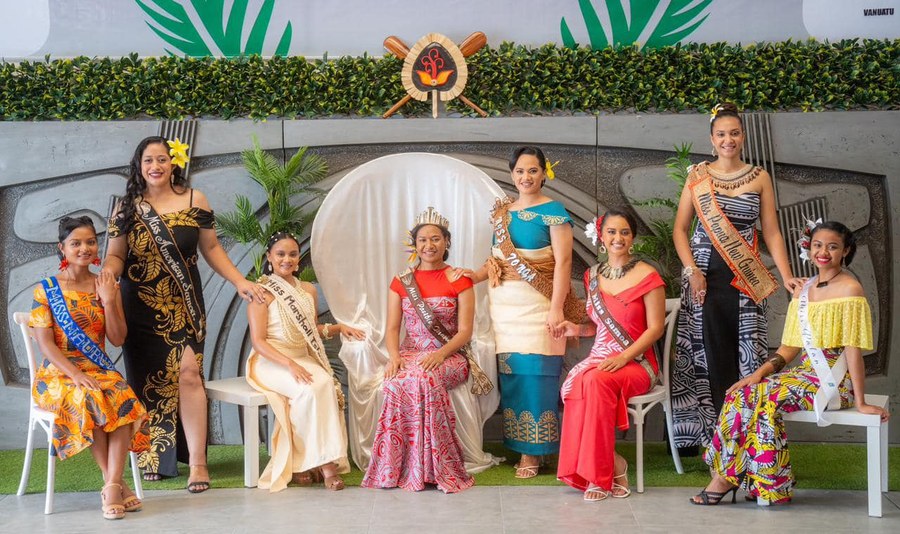
Photo source: PNG Haus Bung
In February this year, a nineteen-year-old economics student from the Western Highlands stood on a stage in Fiji in a hand-woven bilum dress, representing Papua New Guinea at the Miss Pacific Islands pageant. The theme that year, with an irony nobody in the room seemed to catch, was “One Pacific, One Voice: Standing Together for Online Safety.” Iampela Popena came second overall, then topped the pageant’s own “Miss Internet” poll for racking up more online engagement than any other contestant. Then the same internet that voted for her turned on her: coordinated, racist attacks on her appearance, her family, her background, serious enough that the UN’s development agency in PNG wrote up her case, warning that this kind of pile-on is starting to push talented young women out of public life altogether. If that sounds familiar, it’s because it happened to the woman who held the title before her, too. May Torowi Hasola spent her reign as Miss PNG fielding abuse over her skin colour, serious enough that our Prime Minister and Police Minister had to publicly weigh in, and officials talked about banning Facebook over it.
So here’s my question, and I would genuinely like an answer: whose empowerment, exactly, are we funding here?
Full disclosure, since an honest columnist should give you his bias upfront: I’ve never liked pageants, and nothing in the research below changed my mind. But dislike isn’t an argument on its own, so let’s look at what actually happens.
“Empowerment” is the word everyone reaches for. It’s on the banners, in the government press releases, in every chairlady’s speech at every crowning. Strip away the sash and the smile, though, and a beauty pageant does one specific thing: it puts a woman’s body on a stage to be looked at, judged and ranked, in service of somebody else’s benefit — a sponsor’s brand, a province’s tourism numbers, a minister’s photo opportunity. Uganda learned this the hard way in 2019, when a junior tourism minister proposed a competition literally called “Miss Curvy Uganda,” designed to showcase what he called voluptuous women to pull in foreign tourists. The backlash was so fierce that the President himself rejected it and denied it ever had cabinet approval. A Ugandan academic who studied the fallout, Francis Akena, later characterised the whole episode, in his own analysis, as the commodification of women’s bodies dressed up as tourism strategy. PNG hasn’t had its own “Miss Curvy” scandal yet, but we’re closer to that logic than we’d like to admit. Last September, when Sandaun Province crowned its first-ever “Miss Bird of Paradise,” the Minister for Tourism, Arts and Culture called tourism “the pot of gold for this country” and said pageants like it would help bring that gold into the province. Not culture. Not education. Not women’s advancement. Gold.
None of this is new, or even ours. The first Miss America was crowned in Atlantic City in 1921, and nobody pretended it was about anything but tourism — the whole contest was invented to keep visitors in town past Labor Day. The winner, Margaret Gorman, was sixteen years old. A hundred and five years later, PNG’s provinces are opening pageant after pageant of their own — Sandaun, Western Highlands, Jiwaka, more queuing up — and calling it cultural pride and rural inclusion. Maybe it’s partly that. It’s also the same old tourism trick, with a bilum draped over it instead of a swimsuit.
Here’s what actually happens to the women standing under those lights. A 2003 study of 131 American pageant contestants found that nearly half wanted to be thinner, 57 percent were actively dieting, and a quarter had been told, or believed, they had an eating disorder — one that, on average, had taken hold at sixteen. A smaller study comparing women who’d competed in childhood pageants against those who hadn’t found the former group carrying more body dissatisfaction and distrust of others into adulthood; the sample was tiny, eleven women each, so I won’t pretend that proves causation, only that it’s a warning sign nobody’s chased up properly. It’s consistent enough with everything else that the American Psychological Association’s own task force on the sexualisation of girls used child pageants as a textbook case: girls barely out of kindergarten, fitted with false teeth and hairpieces, coached to flutter their lashes for a panel of adult judges. That isn’t culture. That’s rehearsing a five-year-old for an adult’s idea of attractiveness, and the message it sends every watching eight-year-old is simple: this is what a woman is for.
Now follow the money, because in PNG we always should. The Tourism Promotion Authority put K250,000 into hosting the regional pageant here in 2019. Five years later, the same authority chipped in another K300,000 to help launch our own national version, with the minister of the day calling it a strategic tourism product. A cash prize on top of that is K20,000. Multiply that across every province now racing to crown a queen, and ask honestly what the country gets back for it. More tourists? Nobody’s shown me the arrival numbers. More educated women? We already run scholarship and grant schemes that don’t require anyone to walk a stage in heels first. More national pride? Ask Hasola and Popena how proud the comment sections made them feel. And before anyone says I’m only picking on grown women who chose this — the same instinct shows up lower down, in high school “Miss” fundraisers, where teenage girls compete for votes that are bought with real money. I’d like someone to explain to me what exactly we’re teaching a fifteen-year-old there, other than that her popularity has a price, and her family is expected to pay it.
In fairness, the defenders of pageantry have a real point, and an honest argument has to hold it. Some women walk away with scholarships, genuine platforms, and real confidence. Sarah Palin was a beauty queen before she was a governor. Miss Solomon Islands Elsie Polosovai spent her reign pushing for better women’s healthcare at her own national hospital, not just posing for photos. Choosing to compete, and gaining something real from it, doesn’t stop being true just because I dislike the system underneath it. But agency and exploitation aren’t opposites. They can sit in the same pageant, under the same lights, on the same night. Popena genuinely used her platform to talk about youth empowerment. That doesn’t cancel out what happened to her the moment the cameras went off and the comments opened.
What I keep coming back to is this: we hand a young woman a sash, tell her she’s now the face of the nation, put her photograph everywhere we can, and then act shocked — genuinely, ministerially shocked — when the nation she’s representing turns around and picks her apart for how she looks. We didn’t build a system that empowers women. We built a system that puts them on display and then apologises to them afterward.
Next year, PNG will crown another queen, hand her a new sash, and send her out to be looked at by the world all over again. When the abuse starts — and on current form, it will — are we going to call that empowerment one more time, or are we finally going to ask what, exactly, we’ve been paying for?