
Economy
IMF: The Colonialism You Don't See
by Li Richards · August 24, 2026
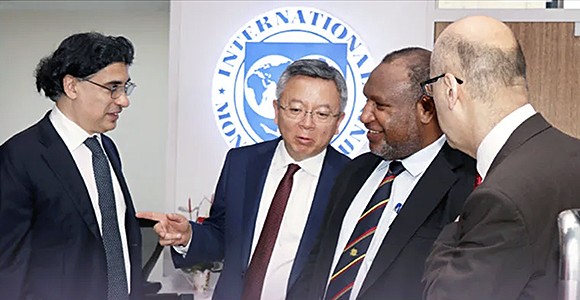
Photo source: Business Advantage PNG
Ask any mother doing the market run in Madang why rice costs more than it did last year and she'll give you one word: “gavman.” Government. It's the word PNGans reach for when they mean everything and nothing at once — tax, fuel price, exchange rate, all of it lumped together because from where she's standing it all comes from the same direction. She's not wrong to lump it together. Somewhere in that lump, quietly, is an institution in Washington DC that most of PNG has never heard of but that has more say over her rice price than she does. So let me ask you the question I've been sitting with for weeks now: when was the last time you heard of a country that went to the IMF poor and came out rich?
Go on. Think about it. I'll wait.
You can't, because it doesn't happen. What happens instead is a pattern so consistent it should have its own name by now. A developing country runs into trouble — sometimes its own fault, sometimes not — and the International Monetary Fund arrives with a chequebook and a checklist. The chequebook buys you breathing room. The checklist rewrites your laws. Zambia took the checklist in the 1980s and 90s and got IMF-driven civil service downsizing and trade liberalisation that pushed unemployment and poverty up, not down. Ghana took it and watched cuts to health and education spending curtail the very services meant to lift people out of poverty, even while the macroeconomic scoreboard looked tidier. Argentina took the biggest loan in IMF history in 2018, $57 billion, built on rosy growth forecasts that never showed up — and got GDP collapsing over 30% and unemployment above 27% for its trouble. The Fund itself later admitted, in that bloodless technocratic way institutions admit things, that it had underestimated how badly its own medicine would hurt the patient. Three continents, three different decades, one repeating story: the loan comes with a scalpel, and the poorest people hold still while somebody else operates.
Here's where I have to be honest with you, because a columnist who only tells you the parts that fit his argument is just a propagandist with better grammar. Sri Lanka gets thrown around a lot as an IMF horror story, and I nearly used it here myself. But dig into it and the timeline is inconvenient for the “IMF ruins everything” thesis: Sri Lanka's own government spent years running fiscal deficits it couldn't finance, printed money to paper over the gap, and pegged its currency to the dollar long after the maths stopped working. It defaulted on its debt in April 2022 — the first time in its history — and only then did it go, cap in hand, to the IMF. The Fund didn't blow up Sri Lanka. Sri Lanka blew itself up and the IMF showed up afterward as the fire brigade, a fire brigade that, fair enough, has its own history of turning up late and hosing down the wrong building. That distinction matters, because if we're going to accuse the IMF of colonialism, we owe it the same rigor we'd demand from anyone else standing in the dock. Exaggerate the charge sheet and you hand the defence its easiest win.
Which brings us home, to the actual charge sheet PNG should be reading. Since 2023 we've been under a 38-month IMF credit arrangement, and on paper the story is good news wrapped around Marape like a ribbon: the fiscal deficit narrowed to 2.4% of GDP in 2025 from 3.3% the year before, capital spending as a share of GDP rose for the first time since 2021, and the Prime Minister's own office put out a press release with the headline “PNG's Economy Rebounding Strongly Under Home-Grown Reform Plan.” Home-grown. That word is doing a lot of heavy lifting for a reform plan that's being graded, reviewed, and adjusted every few months by a team flying in from Washington. Underneath the good headline number, the actual work of these reviews is rewriting how our tax office chases revenue, how our central bank governs itself, how government cash gets swept into central accounts, and how commercial banks report suspicious transactions. None of that is inherently sinister — a country drowning in debt does need better tax administration and does need a central bank that isn't just an ATM for whichever government is in power. But “necessary” and “ours” are not the same word, and Marape's press office wants you to hear the second when what's actually happening is closer to the first, negotiated by people who don't live here and won't be here when the next election comes around asking who to blame for a new tax bracket.
And then there's the land. PNG is one of the last places on earth where roughly 97% of the ground beneath your feet still belongs to the people whose grandfathers are buried in it, not to the state, not to a bank, not to a company registered in Singapore. That is not a quirky cultural footnote — it is the single largest asset most Papua New Guineans will ever hold, bigger than any wage they'll earn in a lifetime. There has been pressure for years, from the World Bank and, credibly, from the IMF's broader orbit of development advice, to get that land formally registered and “unlocked” for the market. I want to be careful here and not overstate a specific demand I can't nail down to a specific document — but the direction of travel across the whole aid-and-lending ecosystem has been consistent for decades: customary land is treated as underused capital sitting idle, waiting for a title deed to make it real to the international financial system. Idle to whom, exactly? Not to the family growing kaukau on it. Ask yourself why an institution headquartered eleven thousand kilometres away has an opinion at all about who owns a hillside in Simbu.
Compare that, if you want an uncomfortable comparison, to how China does business here. I'll say plainly this is my opinion and not settled fact: the Chinese are transactional and upfront about wanting resources, ports, and influence in exchange for their money, and they generally don't insist we rewrite our banking laws to get it. The Americans, working partly through the IMF, present themselves as the adults in the room protecting us from ourselves, while quietly attaching conditions that reshape our sovereignty one structural benchmark at a time. Both are self-interested. Only one of them pretends not to be.
So here's where I land, and here's my question, aimed squarely at Waigani. Marape, you've taken the good headline and let the fine print through the back door — the falling deficit, the rebounding-economy press release, the applause from Washington. Fine. But when the fiscal consolidation targets tighten further in 2026, when the tax office gets sharper teeth, when the next review comes back with new conditions PNGans never voted on and never read, who's going to be standing in that Madang market explaining to that mother why rice costs more this time? Was it worth it, or did you just sell us a very well-worded IMF report with your face on the cover?